


Hi, it’s David Lambert, and welcome to The Business Growth Blueprint, my bi-weekly newsletter where I delve into the critical elements of business growth—strategy, leadership, operations, and the technologies shaping tomorrow. Subscribe to join 2,300+ readers who get The Business Growth Blueprint delivered to their inbox every week.
Introduction
Every organization claims that accountability is important, but few actually design systems to support it. Too often, accountability is confused with delegation. Leaders assign tasks, hold status meetings, and expect results, only to find that outcomes fall short, decisions stall, and ownership feels fragmented. When this happens, the root issue is rarely a lack of effort or intent; instead, it often stems from delegation that lacks a clear definition of accountability.
At the leadership level, accountability is not about imposing tighter control, raising expectations, or increasing reporting. It is a system that must be intentionally built, reinforced, and modeled.
Delegation involves handing off tasks, while accountability assigns ownership of outcomes. When leaders delegate without clearly defining ownership, success criteria, and decision-making authority, responsibility becomes diluted. Teams may remain busy, but their results can become inconsistent. When accountability falters, it is typically not because individuals don’t care; rather, it is because leaders have failed to create an environment where accountability can succeed.
The distinction between simply delegating work and intentionally designing for accountability is crucial in determining whether execution improves or quietly deteriorates.
For instance, in a fast-growing business I worked with, leaders delegated tasks aggressively to keep up with growth. However, execution slowed because accountability did not scale with the increased workload. The solution was not more oversight; it was establishing clear ownership of outcomes.
Delegation moves work. Accountability moves outcomes.
Let’s dig in.
Please feel free to comment and subscribe - it’s free!
Accountability Starts with Ownership, Not Oversight
High-performing organizations do not depend on constant oversight; instead, they thrive on clear ownership. Accountability arises when individuals understand what they are responsible for, how success is measured, what trade-offs they are allowed to make, and when they can take action without needing permission.
When ownership is ambiguous, organizations often resort to endless alignment meetings, diffuse responsibility, and common phrases like, “that’s not my job.” This makes leadership reactive rather than proactive, spending time addressing conflicts rather than driving results. In contrast, clear ownership speeds up decision-making, and in competitive markets, this advantage becomes significant.
You Don’t Get Accountability Without Standards
One of the most common breakdowns in accountability occurs when leaders ask individuals to take ownership of outcomes without clearly defining the standards by which those outcomes will be judged. In such environments, accountability becomes performative, discussed frequently but applied inconsistently.
Accountability cannot exist without explicit expectations. Effective accountability systems are built on clearly defined metrics, agreed-upon success criteria, and transparent reporting. These standards must be established before execution begins, rather than being applied retroactively once results are known.
When expectations exist only in someone’s mind or shift depending on the audience or the situation, accountability becomes subjective. Performance discussions can become politicized, leading to a loss of trust. Teams often find themselves spending more time explaining results than improving them. Strong leaders eliminate this ambiguity by establishing shared standards that apply consistently across the organization.
When standards are clear, performance discussions become factual, consistent, and fair. Leaders can focus on decisions, trade-offs, and improvements rather than interpretations. This is how accountability transitions from being a leadership aspiration to a repeatable operational discipline.
Metrics Are the Language of Accountability
Accountability cannot exist without data, but not all data promotes accountability. Vanity metrics and activity metrics create movement without delivering real outcomes. True accountability relies on outcome-based metrics that directly connect efforts to results.
The most effective organizations focus on a small set of key measures that answer three fundamental questions: What does success look like? How are we measuring it? How often are we reviewing it? These metrics are defined in advance, regularly reviewed with discipline, and used to guide decisions rather than justify past performance.
When metrics are transparent and consistently reviewed, accountability transforms from a personal responsibility into a cultural norm. Results are discussed openly, gaps are identified early, and conversations center on course correction rather than explanations. Leaders spend less time debating numbers and more time deciding on next steps.
In this environment, metrics are not punitive; they are empowering. They provide clarity, reinforce ownership, and enable teams to act swiftly with confidence.
Accountability Is a Leadership Obligation
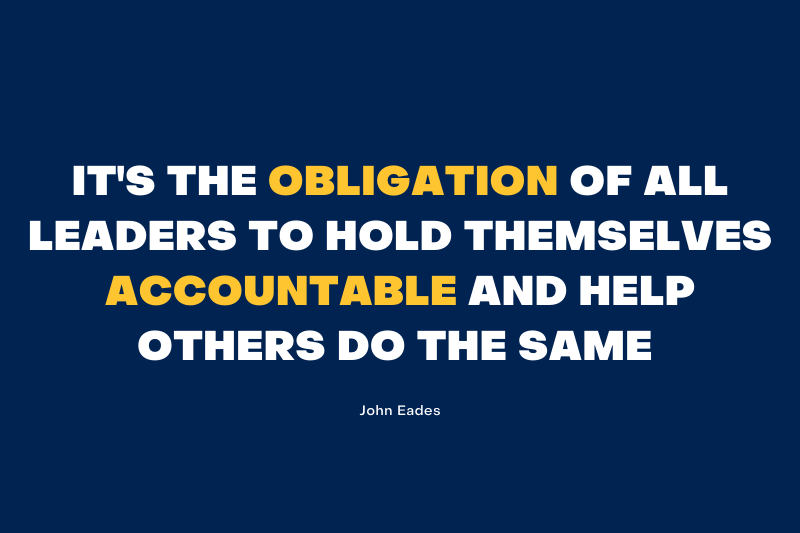
Here’s the hard truth: accountability cannot be delegated if leadership does not model it. This means that leaders must take responsibility for missed commitments, be transparent about trade-offs, hold their peers accountable, not just their direct reports, and make decisions they are willing to stand behind. When leaders consistently model accountability, it spreads throughout the organization. However, when they avoid accountability, it diminishes, no matter how many dashboards or meetings are in place.
When leaders model accountability, it cascades. When they avoid it, the organization follows.
We have witnessed the consequences of confusing delegation with accountability. In the case of the Boeing 737 MAX, tasks were delegated extensively, but accountability for safety outcomes was divided, resulting in catastrophic consequences. In contrast, companies like Netflix incorporate accountability into their operating models. They grant leaders the freedom to act while ensuring clear, unmistakable ownership of outcomes.
Accountability Enables Scale
As organizations grow, informal alignment often deteriorates. What is effective at $10 million may not work at $50 million, and what is successful at $50 million might fail at $100 million.
At larger scales, accountability needs to be structured, measured, and reinforced through clear governance and a consistent operating rhythm. Organizations that scale successfully focus on designing better accountability systems rather than imposing more controls. These systems enable leaders to act more quickly, make more informed decisions, and maintain alignment without hindering execution.
Few organizations demonstrate this better than General Electric during its most successful growth years.
General Electric’s ability to scale effectively over the decades was not due to tighter controls or constant oversight; rather, it stemmed from a thoughtfully designed accountability system.
Under Jack Welch’s leadership, GE established clear accountability through explicit ownership, well-defined standards, and a disciplined operating rhythm. Leaders were granted the autonomy to manage their own businesses, but the expectations were clear, and performance was rigorously reviewed. The implementation of Session C talent reviews, stretch targets, and regular operating reviews ensured that accountability was not merely assumed but actively reinforced.
What made GE successful was not just the act of delegation. While tasks were distributed, ownership of outcomes remained transparent. Leaders were not only aware of their responsibilities, but they also understood how their success would be measured and how frequently results would be evaluated. Accountability flourished because it was integrated into the leadership system, rather than relying solely on individual efforts.
Conclusion: The Bottom Line
Accountability isn’t about creating pressure; it’s about clarity. It involves understanding who is responsible for what, how success is defined, and how progress is measured without any ambiguity or political complications. When accountability is well-defined, execution improves, trust grows, and leaders can focus more on building rather than chasing.
This clarity is essential for organizations to grow intentionally, sustainably, and with confidence.
Sources
Insights and data in this newsletter are drawn from publications and reporting, including:
Accountability vs. delegation in leadership: Harvard Business Review; MIT Sloan Management Review; McKinsey Quarterly.
(Harvard Business Review, MIT Sloan, McKinsey)Leadership accountability and decision rights: Bain & Company RAPID framework; McKinsey decision-making research; BCG organizational design insights.
(Bain & Company, McKinsey, BCG)Ownership, standards, and execution discipline: Patrick Lencioni (organizational health); Roger Connors & Tom Smith (The Oz Principle); Verne Harnish (Scaling Up).
(Jossey-Bass, Wiley, Gazelles)Metrics, operating cadence, and execution: Kaplan & Norton (Balanced Scorecard); Andy Grove (OKRs); John Doerr (Measure What Matters).
(Harvard Business School Publishing, Grove Books, Portfolio)Accountability at scale and growth-stage breakdowns: Harvard Business School case studies; Stanford Graduate School of Business; MIT Leadership Center.
(Harvard Business School, Stanford GSB, MIT)Executive and market context: Wall Street Journal; Financial Times; The Economist.
(Wall Street Journal, Financial Times, The Economist)
I appreciated the framing around accountability as outcome ownership rather than task completion. It raises an interesting tension between responsibility and true ownership, especially in employee context...where autonomy and clarity can exist even without economic stake. Designing for decision authority feels like the real unlock here.
Leadership is a privilege, and doing it well requires continual learning, work, refinement, and discipline. Thank you for this content; it’s very helpful as I guide my team (mainly early career staff).