


Hi, it’s David Lambert, and welcome to The Business Growth Blueprint, my bi-weekly newsletter where I explore the critical elements of business growth—strategy, leadership, operations, and the technologies shaping tomorrow. Subscribe to join 2,800+ readers who get The Business Growth Blueprint delivered to their inbox.
Introduction
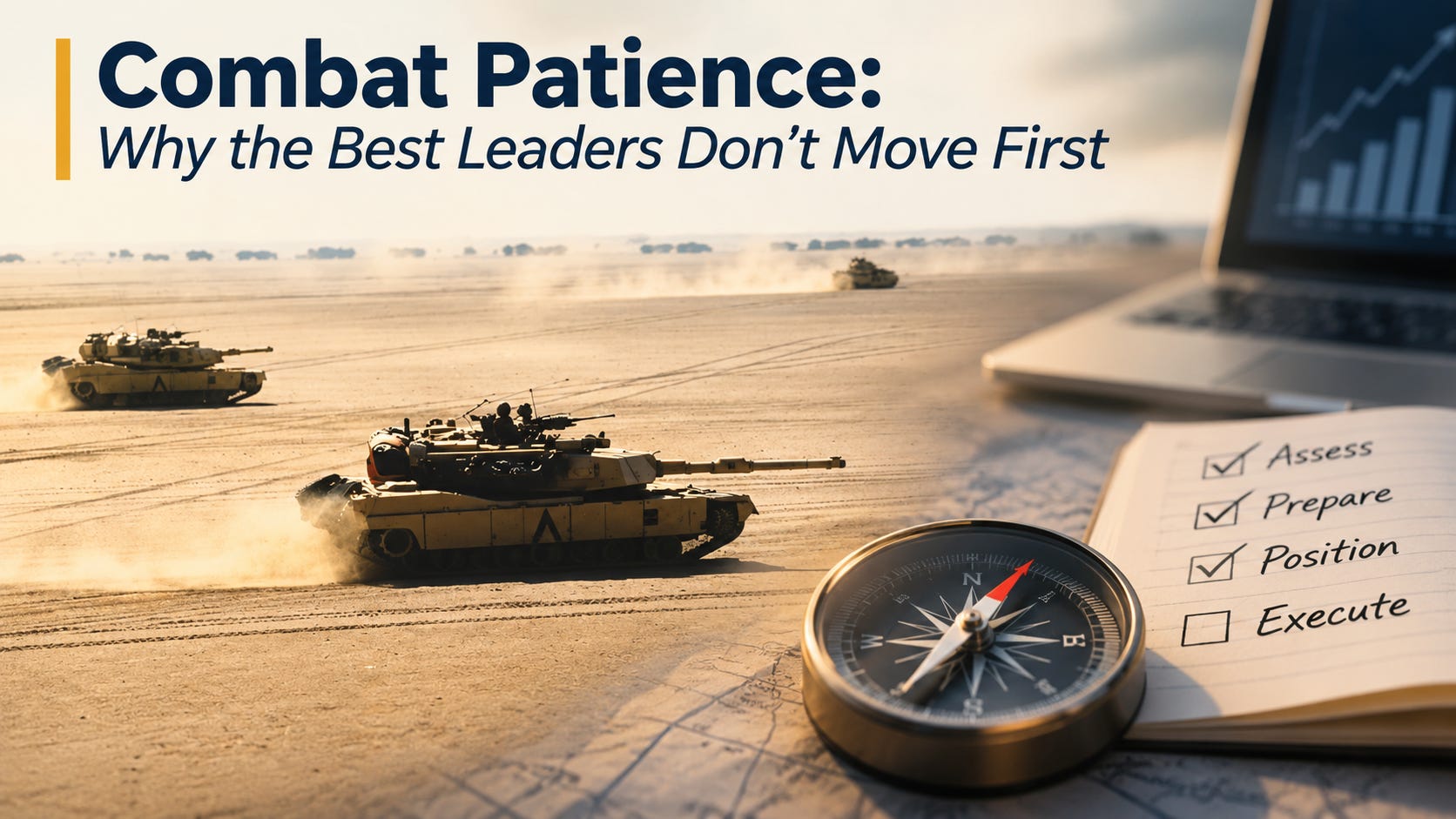
The ground war in Operation Desert Storm (1991) lasted roughly 100 hours. Today, knowing how quickly it ended, it is easy to forget what the months leading up to the war felt like.
Enormous uncertainty hung in the air about what was coming. Saddam Hussein’s forces had invaded Kuwait, hundreds of thousands of American troops were deploying to the Persian Gulf, and no one knew what the cost of removing the Iraqi Army would ultimately be. The public debated whether the war could become prolonged and whether the military draft might eventually be needed. Even at West Point, rumors, the first since World War II, circulated that cadets might graduate early to join the fight.
For those preparing to serve, the possibility of a long and difficult war felt very real. And then the ground campaign began. Roughly 100 hours later, it was essentially over.
From the outside, it looked like an extraordinary display of speed and overwhelming force. But focusing only on those 100 hours misses the more important leadership lesson. The decisive action was possible because of what happened before it.
For weeks, coalition forces shaped the battlefield. Intelligence was gathered. Forces were positioned. Plans were refined. Enemy capabilities were degraded. Leaders worked to create the conditions that gave the ground campaign the best possible chance of success.
Then, when those conditions were right, they moved with extraordinary speed.
The real lesson wasn’t how quickly coalition forces moved. It was the discipline to resist moving before they were ready. Months of preparation made 100 hours of decisive execution possible. What appeared to be extraordinary speed was, in reality, the payoff from knowing when to wait and when to act.
That lesson has shaped how I think about leadership, particularly when the pressure to act is greatest.
In business, we talk constantly about urgency. Leaders push for speed. Teams are encouraged to move faster. Organizations pride themselves on being action-oriented. There is good reason for that. Markets move quickly, customers expect responsiveness, and organizations that cannot execute with speed eventually fall behind.
But urgency without discipline can be just as dangerous as moving too slowly. Sometimes the best leadership decision isn’t “go.” It’s “not yet.”
Let’s dig in.
Please feel free to comment and subscribe - it’s free!
Combat Patience in Business
What is it?
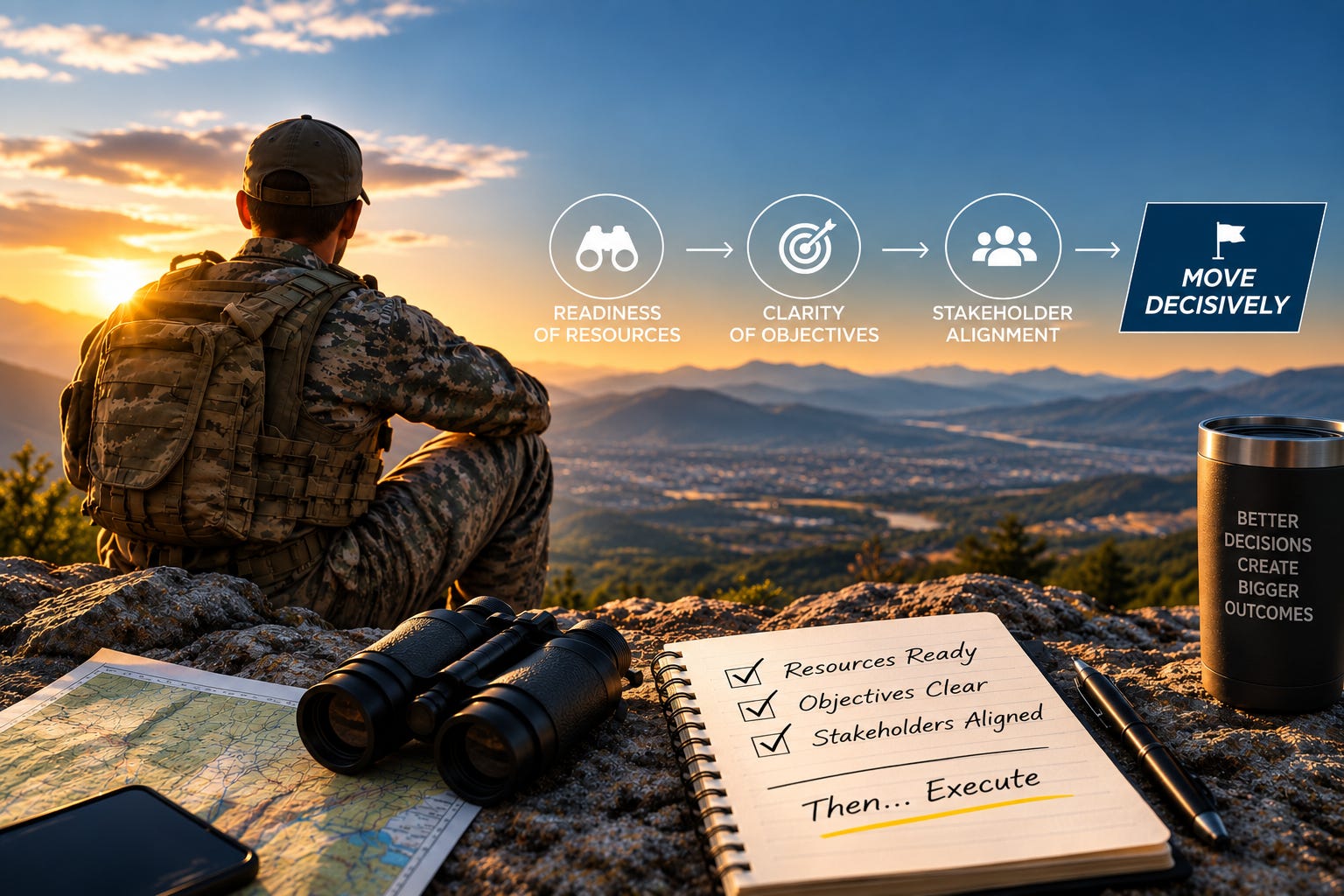
Combat patience involves actively observing specific indicators-such as readiness of resources, clarity of objectives, and stakeholder alignment-that signal when the organization is prepared to move decisively, making the concept more actionable for leaders.
The distinction is important. An indecisive leader doesn’t know what to do. A disciplined leader may know exactly what needs to be done but also understands that when it is done can be just as important as what is done.
That is what makes combat patience difficult. Leaders are conditioned to act. We are rewarded for solving problems, making decisions, creating momentum, and producing results. Sitting still can feel uncomfortable, particularly when everyone around us is moving.
But activity can create a powerful illusion of progress.
Full calendars feel productive. Large sales pipelines feel like growth. New initiatives create excitement. Acquisitions create headlines. Constant movement makes an organization feel as though something is happening.
Motion, however, is not the same thing as progress.
Pressure makes the problem worse. Boards expect growth. Customers want answers. Employees want direction. Competitors are moving. Leaders understandably feel pressure to respond.
Under that pressure, organizations can begin making decisions simply because doing something feels better than doing nothing.
We pursue an opportunity because it is available. We launch an initiative because we already announced it. We enter a market because a competitor did. We add resources before the revenue exists to support them. We scale an operation before the model has been proven.
That is where urgency becomes expensive.
Opportunity Is Not Strategy
I have seen this most often around growth. A significant opportunity appears, and suddenly the conversation changes. “We can’t miss this” becomes the justification for moving forward. I know we’ve all been there.
Maybe it is a large customer outside the company’s core capabilities. Maybe it is a new geography. Maybe it is an acquisition. Maybe it is a large contract with unattractive economics. The opportunity may be completely legitimate, but an opportunity does not necessarily mean it is the right opportunity.
This is where combat patience becomes particularly valuable in business.
The question cannot simply be, “Can we do this?” Leaders also need to ask, “Should we do this, and are the conditions right for us to succeed?” This careful approach can help leaders feel more in control of their choices.
Those are very different questions.
Good strategy is not just deciding what an organization will pursue. It is also deciding what it will not pursue (disciplined risk-taking, not risk avoidance). Discipline can help leaders feel more grounded and clear about where to focus their attention.
Sometimes the most valuable decision an organization makes is the opportunity it chooses not to pursue.
Better Pipeline, Not Just More Pipeline
The Difference Between Activity and Progress
Sales provides a good example. Most organizations celebrate pipeline growth. More opportunities, more proposals, and more pursuits can seem to represent greater growth potential.
But a large pipeline has limited value if much of it consists of opportunities the company should not pursue or is unlikely to win.
A disciplined sales organization understands its ideal customer. It knows where it is differentiated, where it can deliver successfully, and what economics are required to create value for both the customer and the company. Most importantly, it is willing to walk away when those conditions do not exist.
That can be difficult; it’s difficult for me. Turning down a large opportunity can feel like failure, particularly when growth expectations are high. But pursuing the wrong business can be far more damaging than passing on it.
More pipeline does not necessarily create more growth. Better pipeline does.
The same principle applies after the sale/win.
Growth creates its own momentum. One customer becomes three. Three locations become twenty. One market becomes five. Success naturally creates pressure to scale.
But scale magnifies whatever already exists.
If an organization has a strong operating model, scale can create tremendous value. If the operating model is inconsistent, scale produces inconsistency faster. Processes need to work. Systems need to work. People need to understand their responsibilities. Customers need to receive what was promised.
Disciplined operators build the system, prove the model, and then scale.
Patience at that stage isn’t slowing growth. It is protecting it.
Timing Is a Multiplier
A similar misconception in strategy is that the company that moves first will necessarily have the advantage.
Consider Apple’s entry into the smartphone market in 2007. BlackBerry, Nokia, and Palm had already established significant positions in the market. Apple was not first, but it entered with a fundamentally different approach, combining hardware, software, and an intuitive user experience into an integrated platform.
Rather than simply competing with existing smartphones, Apple helped redefine what consumers expected from them. Its success was not about being first. It was about entering with the right capabilities, a differentiated strategy, and the ability to execute.
Being first can certainly be valuable. But being ready can be even more important.
A strong strategy executed before an organization can support it can still fail. The same strategy launched after the organization has built the necessary people, systems, capabilities, and market position can produce an entirely different result.
Timing is therefore not separate from strategy. Timing is part of strategy.
Effort cannot compensate for poor timing. In fact, applying more resources to a poorly timed decision can get an organization to the wrong destination faster.
This is also where the distinction between combat patience and indecision becomes critical. Combat patience cannot excuse endless analysis. There is a significant difference between saying, “We’re not ready to decide,” and saying, “We know exactly what we’re looking for, and the conditions haven’t been met.”
Indecision is characterized by uncertainty, delay, and a lack of ownership. Combat patience requires clear criteria, defined triggers, and situational awareness. The leader knows what must be true before acting. When those conditions are met, execution is immediate.
One of the most useful questions a leader can ask before making a major decision is remarkably simple:
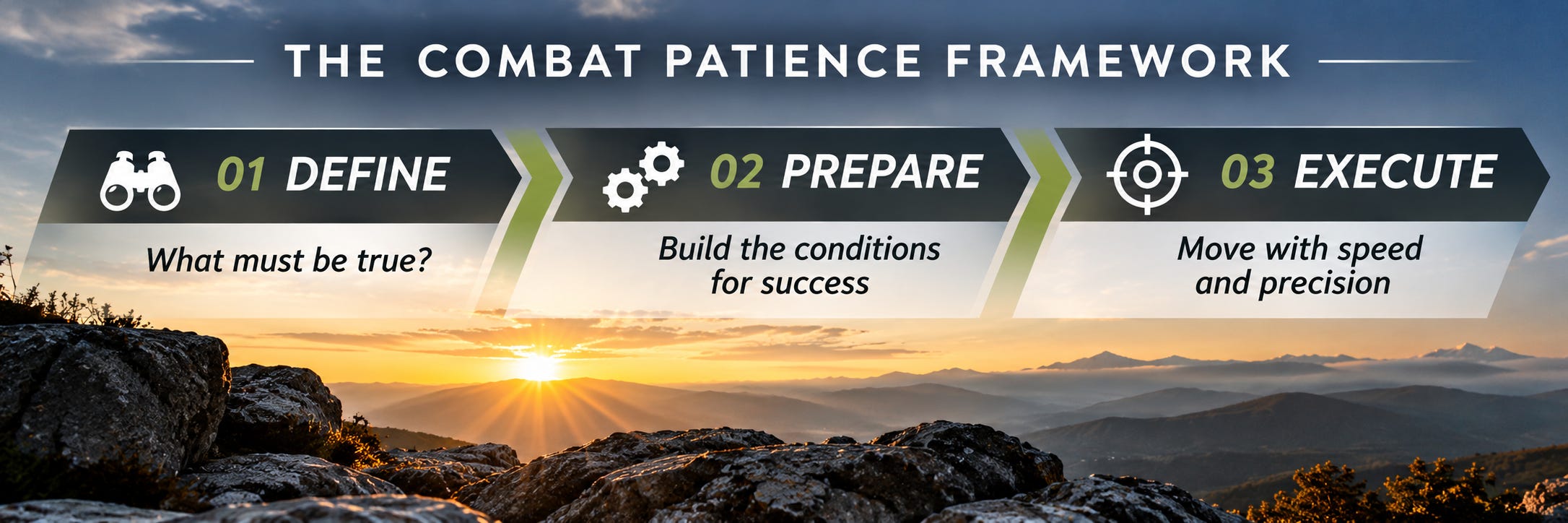
What must be true?
What must be true before we enter this market? What must be true before we pursue this customer? What must be true before we make this acquisition? What must be true before we add significant overhead? What must be true before we scale?
Once those conditions are defined, patience becomes easier because the organization is no longer waiting indefinitely. It is waiting for something specific.
And while it waits, it prepares.
When the Moment Comes
One principle from my military experience has stayed with me throughout my business career: don’t take the shot unless it matters.
Acting too early in a high-stakes environment can expose your position, consume limited resources, and reduce your probability of success. Once you act, you also create consequences that may be difficult to reverse.
The best operators I encountered were not necessarily the people who moved first. They were disciplined about choosing when to move. They observed what was happening around them. They positioned themselves for advantage. They prepared for the moment.
And when that moment arrived, they moved with speed and precision. The same principle applies to leadership. Throughout my career, I have seen leaders rewarded for action. Make the decision. Launch the initiative. Chase the opportunity. Move faster.
There are absolutely moments when that is exactly what leadership requires. A sense of urgency matters. Execution matters. Speed matters. But urgency and patience are not opposites. The best leaders understand when each is required.
Sometimes leadership means having the courage to say “go.” Other times, it means having the discipline to say “not yet.” Not because we are afraid to act. Not because we need another six months of analysis. Not because we lack conviction.
Because the conditions aren’t right. And when they are, move.
That is the paradox of combat patience. The patience comes before the moment. The speed comes when the moment arrives.
The objective isn’t to move first. It’s to be ready to move when it matters.
Conclusion
Leadership is not measured simply by how quickly we act, but by the judgment behind our decisions.
Combat Patience is not about avoiding risk, waiting for certainty, or slowing progress. It is about understanding the risks, preparing for success, and recognizing when the conditions justify decisive action.
The greatest challenge for leaders is knowing the difference between urgency and impatience, between opportunity and strategy, and between activity and meaningful progress.
The best leaders have the discipline to wait, the courage to act, and the judgment to know the difference.
That is Combat Patience.
Sources
Insights and perspectives in this newsletter are informed by leadership research, technology industry analysis, and historical reporting on the mobile phone industry, including:
U.S. Army Center of Military History. Historical accounts of Operations Desert Shield and Desert Storm, including coalition planning, force positioning, battlefield preparation, and the execution of the 100-hour ground campaign
U.S. Department of Defense. Historical reporting and analysis of the Persian Gulf War, including coalition military strategy, operational readiness, risk assessment, and the coordination of air and ground operations
Harvard Business Review. Research and case analyses on strategic decision-making, organizational readiness, leadership judgment, and the challenges of balancing speed with disciplined execution
McKinsey & Company. Research on organizational growth, strategic timing, operational scalability, and the importance of aligning capabilities, resources, and execution with growth ambitions
Richard Rumelt. Strategic analysis of competitive advantage, identifying critical challenges, and the importance of making deliberate choices about where organizations commit resources (Good Strategy/Bad Strategy: The Difference and Why It Matters)
Apple Inc. Historical reporting on the introduction of the iPhone in 2007, its differentiated approach to hardware and software integration, and its role in transforming the smartphone industry (Apple Newsroom)
Michael E. Porter. Research on competitive strategy, strategic positioning, trade-offs, and the importance of choosing which opportunities an organization will and will not pursue (What Is Strategy?, Harvard Business Review)